• A 247-km railway from Udon Thani to Sakon Nakhon and Nakhon Phanom => time to say goodbye 👋 to Highway 🛣️ No. 22 since the new railway line is not supposed to duplicate the existing highway which was opened on the same day as Udon Thani railway station
• A 316-km railway from Nong Khai to Bueng Kan and Nakhon Phanom
=> time to say goodbye to Highway no. 212 since the new railway line has to be not a duplicate of existing Highways
• A 173-km railway from Mukdahan to Amnat Charoen and Ubon Ratchathani => how to construct the line without duplicated the existing highways are still questionable 🤨
https://www.nationthailand.com/news/policy/40049305?
**Revamping Railway Stations: Emerging Economic Hubs to Watch! More Than Just Transit Points**
*Daily News*, May 13, 2025, 18:09
Currently, we often view railway stations merely as transit points. However, a discussion with "Assoc. Prof. Dr. Panit Pujinda" from the Urban and Regional Planning Department, Faculty of Architecture, Chulalongkorn University, shed light on the evolution of railway stations. Today, we delve into the development and hidden potential of these stations.
**The Dynamics of Railway Development**
Looking back to the reign of King Rama V, His Majesty recognized the importance of developing a railway transportation system to elevate the nation to the standards of civilized countries. The initial railway network layout clearly reflected Western influence, with a division in rail gauge standards on either side of the Chao Phraya River. On the Thonburi side, a 1-meter gauge, or Meter Gauge, was laid, following the British model. Meanwhile, the Phra Nakhon side adopted the 1.435-meter gauge, the international standard or Standard Gauge.
In the early stages of railway development, most stations were located in suburban areas to avoid trains entering the city center, which would disrupt settlements and require extensive land use. Thus, early railway stations were typically situated outside the main urban areas but still well-connected to the city's economic centers, serving for both freight transport and passenger travel. They acted as connecting points between Bangkok and various provincial cities. However, markets and economic centers at the time were located within the city, making travel from the stations to the city center reliant on road transport. Given this context, the areas around the stations in the past did not see much residential or commercial development, as the primary goal was transit and "getting out as quickly as possible." The design of railway stations focused mainly on travel and transport, without the need for developing the surrounding areas, a stark contrast to current development concepts like Transit Oriented Development (TOD).
**The Changing Role of Railways: Not Just Transit Points Anymore**
The concept of Transit-Oriented Development (TOD) did not originate with the Thai railway system but emerged later when there was a desire to utilize the potential of the land around stations, and the role of railways began to change. Railway stations are no longer just transit points; the concept of Transit-Oriented Development (TOD) has become more significant. Moreover, railway stations offer improved accessibility. Even stations located in newly developed or less dense areas, when supported by factors such as labor, housing demand, and real development potential, create opportunities for developing the surrounding areas. However, the development concepts for urban mass transit railway stations differ from those for intercity transport. Thai railways still largely adhere to the traditional concept, focusing on transit and the collection of goods from various districts into Bangkok. Not every station has the potential for commercial development, and successful development requires a balance between residential and employment areas (Job-Housing Balance).
**Development Around Stations May Occur Only at Certain Locations; High-Speed Rail Also Faces Uneven Opportunities**
In principle, we can categorize stations based on their potential for Transit-Oriented Development (TOD) into approximately four levels. The first level is central stations, such as Bang Sue Grand Station, which undoubtedly has very high TOD potential. The second level is terminal stations, such as Chiang Mai Station, which are typically located in major cities and have potential secondary to central stations. The third level is junction or intersection stations, such as Ban Phachi Junction or Kaeng Khoi Junction. These stations serve as collection and distribution points for goods and people, with the potential to develop into industrial or logistics centers. The final level is general stations, which usually do not have significant TOD potential. Therefore, the development of areas around stations for Thai railways requires selecting specific stations, as not all are suitable.
However, Thai Railways Still Has Development Opportunities – Something King Rama V Foresaw.
Based on the vision laid out by King Rama V regarding the development of mass transit, the State Railway of Thailand owns land allocated for the operation and transportation of the country. This provides areas along the railway lines to accommodate future development, similar to Chulalongkorn University's concept of using its land, such as Siam and Sam Yan, to generate revenue in line with King Rama V's intention to recognize the potential of railway land for increased income.
**Opportunities and Limitations of Thai Railways?**
High-speed rail represents a significant development, as it is not just about faster travel but a mode of transportation that is replacing short-distance flights. This creates increased demand for economic development due to faster and more convenient connections than air travel. Considering the total travel time to the airport and boarding procedures, for example, traveling by train from Bang Sue Grand Station to Chiang Mai might take only 4 hours, while air travel, including travel to the airport and check-in, could take more than 5 hours. Air travel should be reserved for long-distance flights, and high-speed rail should be developed to serve travel between city centers.
However, the number of Thai railway passengers has significantly decreased, from 40 million in 2012 to only 17 million in 2022. The main problem is the inconvenient transfer from railway stations to final destinations compared to low-cost airlines and private cars, which still have an advantage in terms of price and convenience.
**New City Centers**
In major economic hubs such as Tokyo, Osaka, or in Thailand, like Hua Lamphong, the original city centers are often conservation areas or face development limitations due to old buildings and small land plots. The areas around railway stations, which were once suburban, are therefore suitable for new city development because they have large land plots capable of accommodating high-rise buildings and infrastructure that meets the needs of the modern economy, as seen in the case of Bang Sue Grand Station, which can fully accommodate such development, unlike the area around Hua Lamphong, which is limited by land plot sizes.
Based on the concept of developing railway stations in different formats according to the intensity and potential for economic stimulation, in the context of Thailand, stations can be divided into three main types:
1. **National Hub Stations**, such as Bang Sue Grand Station, which serves as the center of the high-speed rail network and supports new city development due to its large land plots and infrastructure capable of accommodating high-rise buildings and modern economic activities.
2. **Terminal Stations in Major Cities**, such as Chiang Mai Station, which can serve as regional economic centers by using the station to connect tourists, service industries, and urban development.
3. **Junction or Intersection Stations**, such as Ban Phachi Junction or Kaeng Khoi Junction, which have the potential to be centers for raw materials, labor, and industries from various areas, serving as regional distribution points for goods and services. Stations that can effectively stimulate the economy should have common factors, including actual usage demand, large land plots to support development, and surrounding areas that can be developed into economic stimulus projects.
After listening to Assoc. Prof. Dr. Panit Pujinda's insights into the potential of Thai railways, we can envision "Thai Railway Stations" as more than just transit points. They are areas with significant hidden potential in historical, economic, and urban development dimensions, stemming from the foundations laid during the reign of King Rama V to current development concepts.
Railway stations have thus become more than just infrastructure. The success of developing areas around stations depends on understanding the specific role of each station and balancing residential and employment areas, reflecting a long-term vision to ensure that the Thai railway system not only develops for travel but also serves as a crucial factor in driving the country forward in the future.
Ministry of Transport Secures 230 Billion Baht for 22 Major Projects to Boost Economy
Source: Thansettakij
Saturday, June 7, 2025, 06:19 AM
The Department of Highways leads with 130 billion baht.
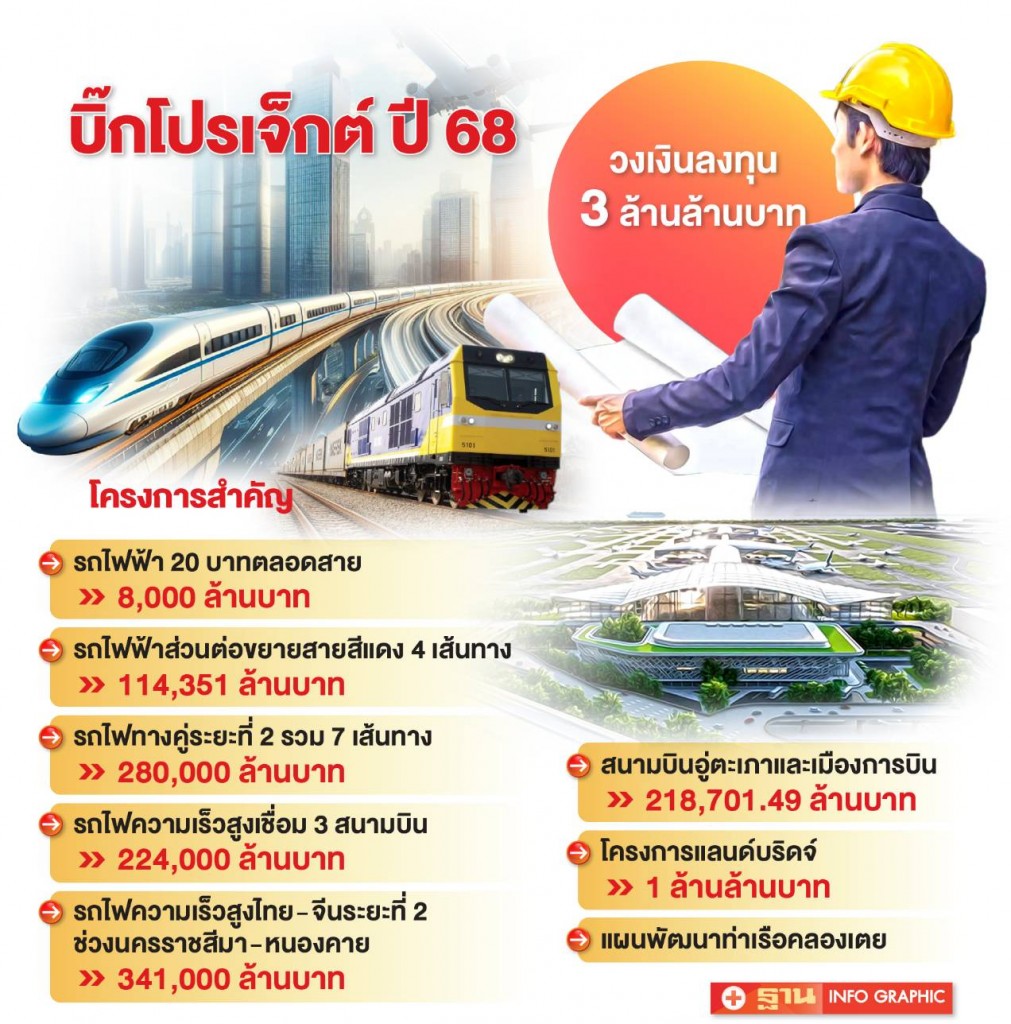
The Ministry of Transport is set to receive a budget allocation of 261 billion baht for the 2026 fiscal year, with 230 billion baht earmarked for investments. This funding will drive 22 urgent mega-projects totaling 910 billion baht to stimulate the economy. The Department of Highways leads the charge with 130 billion baht to develop two motorways, while the Mass Rapid Transit Authority of Thailand (MRTA) will advance four electric train lines. The State Railway of Thailand (SRT) plans to push forward with high-speed rail and phase 2 double-track projects.
The House of Representatives' approval of the 2026 fiscal year budget, totaling 3,780.6 billion baht, is expected to accelerate government spending and employment, particularly in large-scale infrastructure investments, which are a key mechanism for economic growth.
2026 Budget Jumps to 261 Billion Baht
Mr. Suriya Jungrungreangkit, Deputy Prime Minister and Minister of Transport, stated that the Ministry of Transport has received an initial allocation of 261.292 billion baht for the 2026 fiscal year. This marks an increase of 16.71558 billion baht, or 6.83%, from the 2025 budget. The budget is divided into two categories: 1) Regular expenditures of 30.666 billion baht, a decrease of 43.3 million baht, and 2) Investment expenditures of 230.62633 billion baht, an increase of 16.758 billion baht, or 7.84%. The Ministry of Transport's 2026 budget, in its first reading, was presented to Parliament from May 28-31. It will then proceed to committee review and subsequent readings in August.
"Therefore, the government and the Ministry of Transport are confident that the 2026 budget will be finalized and announced before the start of the fiscal year in October 2025, effectively driving the country's economy," said Mr. Suriya.
22 Projects Totaling 910 Billion Baht to Boost Economy
The Ministry of Transport plans to accelerate 22 significant projects under this budget, with a total value of 910 billion baht. These include intercity motorways, expressways, electric railways, high-speed railways, double-track railways (Phase 2), and the Klong Toey Port development project, among others.
Department of Highways Leads with 130 Billion Baht
The 2026 fiscal year budget allocation of 261.292 billion baht is distributed among nine government agencies and five state enterprises.
Government Agencies (200.75618 billion baht):
Office of the Permanent Secretary, Ministry of Transport: 1.1238 billion baht (up 99.28%)
Department of Land Transport: 3.9135 billion baht (up 7.1%)
Department of Rail Transport: 142 million baht (down 2.68%)
Marine Department: 4.253 billion baht (down 13.4%)
Department of Highways (DOH): 131.9322 billion baht (up 3.47%)
Department of Rural Roads: 53.5989 billion baht (up 5.83%)
Department of Airports: 5.3491 billion baht (down 0.13%)
Office of Transport and Traffic Policy and Planning: 274.18 million baht (up 4.67%)
Thailand Institute of Scientific and Technological Research: 168.59 million baht (down 46.2%)
State Enterprises (60.5363 billion baht):
Expressway Authority of Thailand (EXAT): 2.6536 billion baht (up 35%)
Mass Rapid Transit Authority of Thailand (MRTA): 33.25817 billion baht (up 42.9%)
State Railway of Thailand (SRT): 19.418 billion baht (down 9.7%)
Civil Aviation Training Center: 308.2 million baht (up 8.1%)
Bangkok Mass Transit Authority (BMTA): 4.8977 billion baht (up 18.3%)
The Department of Highways (DOH) received the largest allocation of 131.93228 billion baht, an increase of 3.47% from the previous year. This includes 5.40715 billion baht for regular expenditures and 126.52512 billion baht for investment expenditures.
Key projects for the DOH in the 2026 fiscal year include:
Motorway No. 8 (Nakhon Pathom-Pak Tho-Cha-am Section 1, Nakhon Pathom-Pak Tho): 61 kilometers, 61.154 billion baht.
Motorway No. 9 (M9) Outer Ring Road, Western Bangkok (Bang Bua Thong-Bang Pa-in): 16 billion baht, with a plan to propose it to the cabinet soon.
Highway expansion projects to support transport and logistics: 11.621 billion baht.
Maintenance and management of highway and bridge networks: 36.589 billion baht.
Advancing Four Electric Train Lines
The Mass Rapid Transit Authority of Thailand (MRTA) received an allocation of 33.25817 billion baht, an increase of 42.9%. This includes 6.90502 billion baht for regular expenditures and 26.35314 billion baht for investment expenditures. Important MRTA projects for the 2026 fiscal year include:
MRT Purple Line (Khlong Bang Phai-Rat Burana and Khlong Bang Phai-Tao Poon): 3.642 billion baht.
MRT Purple Line (Tao Poon-Rat Burana): 130.60 million baht.
MRT Yellow Line (Lat Phrao-Samrong): 2.505 billion baht.
MRT Pink Line (Khae Rai-Min Buri): 2.250 billion baht.
MRT Orange Line (Bang Khun Non-Thailand Cultural Centre): 12.557 billion baht.
The State Railway of Thailand (SRT) received an allocation of 19.41853 billion baht, a decrease of 9.7%. This comprises 8.08199 billion baht for regular expenditures and 11.33654 billion baht for investment expenditures.
Boosting High-Speed and Double-Track Rail
Key SRT projects for the 2026 fiscal year include:
Light Red Line Suburban Railway (Siriraj-Taling Chan-Salaya): 20.5 kilometers, 15.176 billion baht.
Dark Red Line Suburban Railway (Rangsit-Thammasat University, Rangsit Campus): 8.84 kilometers, 6.473 billion baht.
Ban Phai-Mukdahan-Nakhon Phanom railway construction: 355 kilometers, 66.848 billion baht.
Chumphon-Surat Thani double-track railway construction: 168 kilometers, 30.422 billion baht.
Khon Kaen-Nong Khai double-track railway construction: 167 kilometers, 28.679 billion baht.
Surat Thani-Hat Yai Junction-Songkhla double-track railway construction: 321 kilometers, 66.270 billion baht.
Den Chai-Chiang Mai double-track railway construction: 189 kilometers, 68.222 billion baht.
Hat Yai-Padang Besar double-track railway construction: 45 kilometers, 7.900 billion baht.
High-Speed Rail Phase 2 (Nakhon Ratchasima-Nong Khai): 357 kilometers, 340 billion baht.
Additionally, there is an integrated plan for the Eastern Economic Corridor (EEC) for the High-Speed Rail linking 3 Airports (Don Mueang-Suvarnabhumi-U-Tapao), with a budget of 230.80 million baht.
Two Expressways to Tackle Traffic in Bangkok and Phuket
The Expressway Authority of Thailand (EXAT) also has important projects to push forward in the 2026 fiscal year:
Kathu-Patong Expressway, Phuket (Phase 1): 3.98 kilometers, 16.759 billion baht. The Ministry of Transport is preparing to propose this to the cabinet soon. Phase 1 is expected to open for bidding for civil works by September 2025, with construction starting in 2026 and taking 4-5 years. It is planned to open by 2030.
Northern Expressway Phase 3, Section N2 (Prasert Manukitch Road-Outer Ring Road, Bangkok): 11.3 kilometers, 16.960 billion baht. EXAT plans to propose this project to the Ministry of Transport for consideration and cabinet approval by July 2025, with bidding by September 2025. It is expected to open by 2029.
Scrutinizing the Port Upgrade Plan
Mr. Kriengkrai Chaisiriwongsuk, Director-General of the Port Authority of Thailand (PAT), stated that the development plan for Klong Toey Port, covering an area of 2,353 rai (approximately 930 acres) and valued at around 100 billion baht, aims to transform it into a special economic zone for Bangkok. This leverages its strong location along the Chao Phraya River in the heart of Bangkok, a prime destination for international tourists.
PAT plans to spend approximately six months reviewing the project's feasibility study. Following this, the process for drafting Terms of Reference (TOR) to hire a consultant for the project will begin. The study is expected to take six months to complete before its findings are presented to the cabinet in Q1 2026. Initial construction will focus on the waterfront area (approximately 520 rai or 206 acres) due to its high potential for commercial development.
Source: Thansettakij Newspaper, Issue dated June 8-11, 2025
You cannot post new topics in this forum You cannot reply to topics in this forum You cannot edit your posts in this forum You cannot delete your posts in this forum You cannot vote in polls in this forum


 Forum FAQ
 Search
 Usergroups
 Profile
 Log in to check your private messages
 Log in